Lake Oswego homes often feature duct systems installed decades ago when the area developed around its lake and wooded terrain. These older runs collect fine silt from nearby construction and seasonal pollen that filters through unsealed joints during the long wet months. Furnace and duct cleaning here requires mapping each branch before agitation because many properties sit on sloped lots where return paths run under crawl spaces that stay damp year round.
Pacific Northwest winters keep furnaces running steadily without the deep freezes that dry out systems elsewhere. That constant airflow pulls in road dust from Highway 43 corridors and leaf debris from mature landscaping common in the neighborhood. Technicians must use lower static pressure during cleaning to avoid disturbing original metal ducts that have settled with the soil movement typical along the Willamette River basin.
Access points in Lake Oswego attics frequently sit above finished ceilings with limited entry, so equipment must be broken down to fit through standard scuttle holes. Post-clean verification includes checking for disconnected flex runs that appear after years of vibration from the frequent temperature swings between 40 and 55 degrees common here.
Access Challenges in Local Housing Stock
Many Lake Oswego properties built between the 1960s and 1980s have trunk lines routed through finished basements or tight knee walls. Furnace and duct cleaning crews plan extra time to remove and replace register boots without damaging hardwood floors or tile that homeowners have added during renovations.
Technician insight
In Oregon, the thing that catches most people out with furnace and duct cleaning is how the constant mild dampness in Lake Oswego crawl spaces lets fine silt and mold spores travel through unsealed joints in homes built before the 1980s. Homeowners often skip checking under the house until the furnace has already pushed the material into living areas.
Hidden Debris in a Lake Oswego Split-Level
Problem: recurring musty odor when heat ran. What we found: settled organic dust in the return trunk under the lower level that had entered through an unsealed joint near the foundation. What we did: mapped the run, agitated under negative pressure, and resealed the joint after extraction. Outcome: odor eliminated and airflow restored without opening finished walls.
How it works
- 1
Initial System Mapping
Technicians trace every supply and return run from the furnace in the utility area to exterior terminations, noting access limitations common in Lake Oswego crawl spaces and attics.
- 2
Negative Pressure Setup
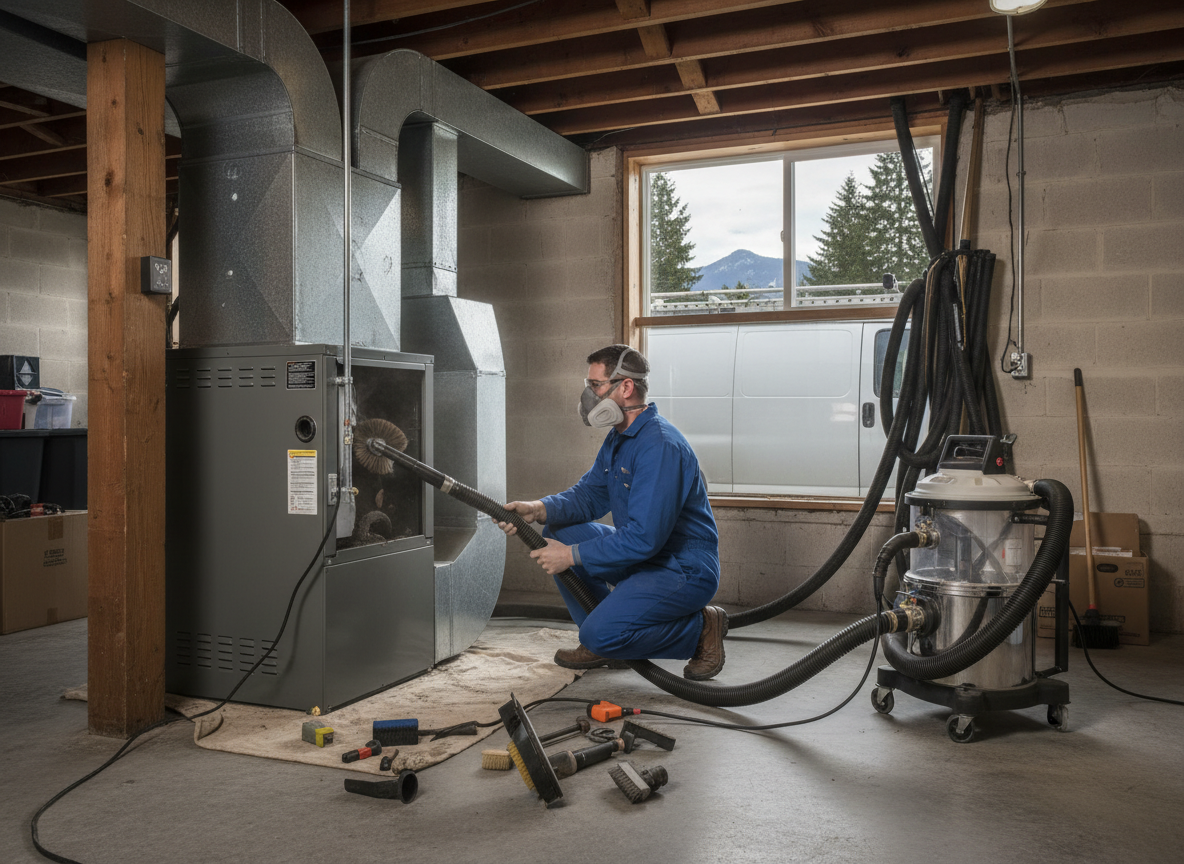
Equipment connects at the main trunk to contain debris while brushes and compressed air agitate interior surfaces without forcing particles into living spaces.
- 3
Targeted Agitation and Extraction
Sections are cleaned sequentially starting from the farthest branches, with continuous vacuum to handle the fine organic matter that accumulates during Oregon's extended rainy season.
- 4
Final Inspection and Reassembly
All connections are checked for gaps before registers are replaced and the furnace is cycled to confirm airflow returns to normal levels.
Pricing
Pricing depends on number of runs, access difficulty in older Lake Oswego homes, and whether crawl space or attic work is required; upfront quotes provided before work begins.