2026-09-07 · Scott Langford
How Lake Oswego's Rainy Season Affects Air Ducts
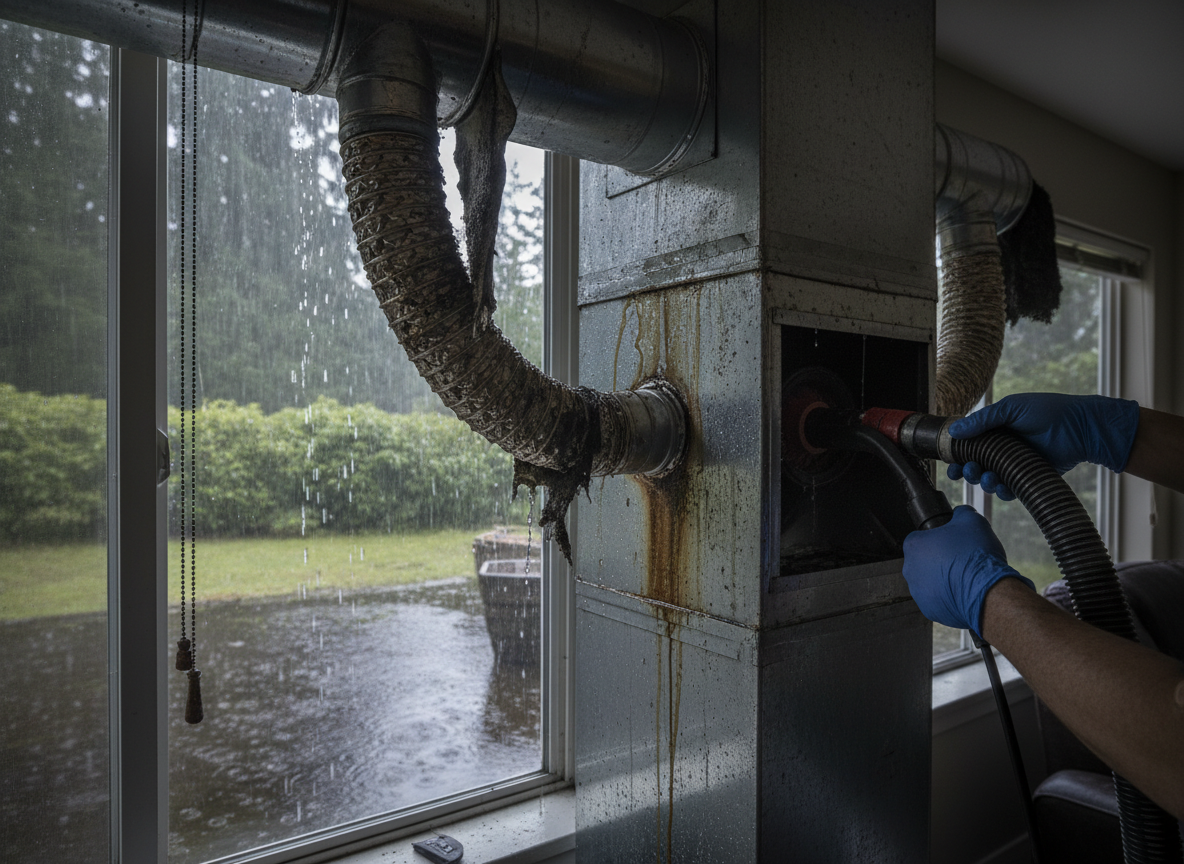
Lake Oswego's rainy season raises indoor humidity enough that moisture reaches air ducts and supports visible mold colonies within days when leaks or poor insulation allow water entry. Homes in Lake Oswego and nearby Clackamas County neighborhoods often sit on older foundations with crawl spaces that collect rainwater, sending damp air through the same ducts used for heating and cooling.
Rainy Season Humidity and Condensation Patterns
Lake Oswego receives prolonged rainfall from October through April that keeps relative humidity above 70 percent for weeks at a time. This moisture migrates into attics and wall cavities where supply and return ducts run, creating condensation on metal surfaces when indoor air cools at night. In single-story ranch homes common along Boeckman Road and in the Lakewood area, ducts often sit in unconditioned spaces with minimal insulation, so temperature swings turn humid air into water droplets that collect at joints and elbows. Over multiple weeks the accumulated moisture softens insulation and creates dark streaks along duct seams that indicate ongoing wetting.
Mold Growth Risks in Local Housing Stock
Lake Oswego contains many homes built between 1960 and 1990 whose duct systems were installed before modern vapor barriers became standard. Once water enters these older galvanized ducts, mold can colonize fiberglass liner within 48 hours and spread spores through every room when the blower runs. Residents near Oswego Lake and in First Addition report musty odors strongest after heavy November rains because crawl-space vents pull damp air directly into return plenums. The same pattern appears in split-level houses on South Shore Boulevard where basement ducts sit close to soil that stays saturated for months.
Effects on Airflow and System Performance
Moisture-laden air carries fine silt from nearby construction sites and garden soil into filters and coils. When this material mixes with condensation inside ducts it forms a sticky layer that narrows airflow paths and forces the furnace or heat pump to run longer cycles. In Lake Oswego's cool, damp winters the reduced airflow also prevents even heat distribution, leaving upper floors colder while lower levels feel stuffy. Homeowners notice higher utility use and uneven temperatures first in larger two-story properties along Country Club Road where long duct runs cross multiple unheated zones.
Practical Steps for Homeowners
Inspect accessible duct sections in crawl spaces and attics after any stretch of rain lasting more than three days. Look for water stains, soft insulation, or dark patches at seams. Keep gutters and downspouts clear so roof runoff does not pool near foundation vents that feed crawl spaces. Replace filters every 30 days during peak rainy months rather than the usual 90-day schedule. Schedule a full duct inspection if musty smells appear when the system first turns on each fall.
When Professional Cleaning Becomes Necessary
If visible mold covers more than a few square feet or airflow has dropped noticeably, contact a local service that uses negative-air machines and agitation tools suited to Pacific Northwest conditions. VentPure Pro operates 24 hours a day from 5200 Meadows Rd, Ste 150, Lake Oswego, OR 97035 and serves homes throughout Clackamas County and surrounding Oregon communities. Technicians can assess moisture sources before cleaning so the job addresses both the ducts and the conditions that allowed water entry.